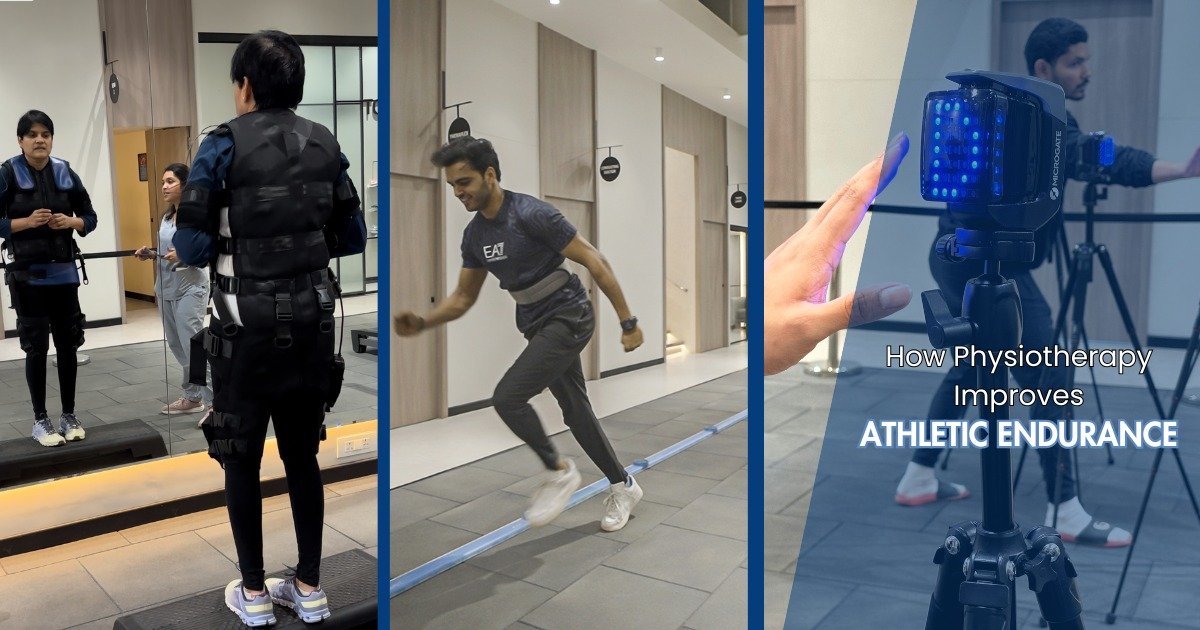
Featuring OptoGait, VO2 Max Cardio Coach, Witty Agility and Endurance System, and Sports Injury Prediction Systems
Athletic endurance determines how long an athlete can sustain high-intensity performance without fatigue. It influences speed, agility, stamina, recovery, and long-term performance capacity. Today, physiotherapy for endurance is far more advanced than traditional stretching or strengthening. It uses scientific tools like OptoGait, VO2 Max Cardio Coach Assessment, Witty Agility and endurance systems, and Sports Injury Prediction technology to upgrade athletic performance.
This detailed guide explains exactly how physiotherapy improves endurance using movement science, oxygen analysis, agility technology, neuromuscular training, and predictive injury systems.
Understanding Athletic Endurance
Endurance is influenced by:
- Aerobic capacity
- Oxygen utilisation
- Anaerobic threshold
- Biomechanics and movement economy
- Neuromuscular control
- Strength and flexibility
- Agility and reaction time
- Fatigue resistance
- Recovery rate
- Injury prevention
Physiotherapy scientifically improves each of these elements.
1. OptoGait: Advanced Movement & Gait Efficiency Analysis
OptoGait is a world-class optical gait and movement analysis system used globally in elite sports performance labs. It measures micro-details of movement that the eye cannot detect.
What OptoGait Measures
- Stride length
- Step frequency and cadence
- Ground contact time
- Flight time
- Foot strike and loading
- Left–right symmetry
- Knee and hip movement dynamics
- Efficiency of acceleration and deceleration
- Jump analysis for power and fatigue resistance
Even minor biomechanical inefficiencies can cause early fatigue during sport.
How OptoGait Improves Endurance
- Corrects energy-wasting running patterns
- Improves stride economy and rhythm
- Reduces premature muscular fatigue
- Lowers the metabolic cost of movement
- Enhances running and sprinting efficiency
- Reduces risk of overload injuries
OptoGait is essential for runners, football players, cricket athletes, badminton players, and overall athletic endurance development.
2. VO2 Max Cardio Coach: Scientific Stamina & Aerobic Capacity Testing
The VO2 Max Cardio Coach system measures the body’s ability to use oxygen during intense exercise.
What VO2 Max Cardio Coach Measures
- Maximum oxygen consumption
- Aerobic vs anaerobic thresholds
- Breathing efficiency
- Lactate threshold
- Fatigue markers
- Heart-rate performance zones
- Post-exercise recovery efficiency
How VO2 Max Cardio Coach Improves Endurance
- Builds precise heart-rate training plans
- Improves oxygen delivery and usage
- Enhances long-distance performance
- Helps athletes train efficiently without burnout
- Increases speed endurance
- Improves game-time stamina and performance consistency
VO2 Max is the strongest measure of athletic endurance.
3. Witty Agility and Endurance System: Endurance Through Agility Performance
The Witty Agility system measures reaction, footwork, and high-speed direction changes.
What Witty Agility Trains
- Reaction time
- Change-of-direction speed
- Lateral movement
- Sprint acceleration
- Neuromuscular coordination
- Real-time decision-making
Why Agility Improves Endurance
Agility is endurance at speed. Efficient movement patterns allow athletes to sustain performance without excessive energy waste.
Agility endurance is essential for:
- Football
- Tennis
- Badminton
- Cricket
- Hockey
- Basketball
- Pickleball
- Paddle Ball
- Combat sports
Better agility equals better stamina during multi-direction sports.
4. Sports Injury Prediction: The Missing Piece in Endurance Training
Endurance collapses when athletes get injured. Modern physiotherapy uses Sports Injury Prediction models and technology to identify risk before injuries happen.
What Sports Injury Prediction Identifies
- Asymmetrical movement patterns
- Weak links in the kinetic chain
- Joint overload patterns
- High-risk landing mechanics
- Fatigue-based movement deviation
- Biomechanical compensation
- Reaction-time delays and coordination issues
How Injury Prediction Improves Endurance
- Prevents breakdown periods in training
- Helps athletes train consistently
- Supports long-term stamina development
- Reduces risk of repetitive strain injuries
- Improves muscle balance and joint stability
Preventing injuries equals sustained endurance growth.
5. Strength & Conditioning for Muscular Endurance
Strength supports stamina. Physiotherapy builds strength endurance using:
- Functional strength training
- Hip-glute conditioning
- Core stability programs
- Lower-body power drills
- Plyometric conditioning
- Posterior chain strengthening
Stronger muscles fatigue slower and maintain technique longer.
6. Mobility & Flexibility Enhancement
Mobility affects endurance directly. Physiotherapy uses:
- Joint mobilisation
- Myofascial release
- Dynamic stretching programs
- Flexibility mapping
- Muscle activation training
Improved mobility leads to smoother, more efficient movement with less energy cost.
7. Neuromuscular Conditioning for Long-Duration Performance
Endurance is also neuromuscular. Physiotherapists train:
- Balance control
- Reaction timing
- Stability under fatigue
- Footwork patterns
- Coordination under load
This creates athletes who maintain technique even in late-game fatigue.
8. Recovery Techniques That Strengthen Endurance
Recovery determines the progress of an endurance athlete. Physiotherapy uses:
- Cryotherapy
- Soft tissue release
- Contrast therapy
- Mechanical recovery devices
- Breathing and oxygenation training
- Load monitoring and recovery planning
Better recovery = better endurance gains.
How Physiotherapy Builds Complete Endurance
Physiotherapy enhances endurance through:
- OptoGait movement optimisation
- VO2 Max Cardio Coach oxygen utilisation enhancement
- Witty Agility speed-agility-stamina integration
- Injury prediction to prevent training setbacks
- Strength endurance training
- Mobility development
- Neuromuscular performance
- Superior recovery systems
This combination builds athletes who perform longer, fatigue slower, and recover faster.
Any athlete aiming for stamina building, agility training, or overall endurance improvement benefits from this system.
Conclusion
Physiotherapy is a powerful performance enhancer for athletes looking to build endurance. With advanced technology like OptoGait, VO2 Max Cardio Coach, Witty Agility, and Sports Injury Prediction, athletes gain structured, data-driven insights that improve stamina, movement efficiency, agility, and long-term performance.
Endurance improves not just by training harder—but by training scientifically.